How to show your headache diary to your doctor
To show your headache diary to your doctor, bring a short written summary instead of scrolling through an app during the appointment: how many headache days per month, how intense they were, which medication you took and on how many days, and anything that seemed to set attacks off. A one-page PDF covering the last few weeks works best.
What does a doctor look for in a headache diary?
A headache diary is a dated record of each headache's timing, intensity, symptoms, and medication use. GPs and neurologists read it for four things above all:
- Frequency. Headache days per month is the number most decisions hang on, and the one memory gets wrong most often.
- Intensity and duration. How bad, and for how long, separates a background nuisance from attacks that take days away from you.
- Medication days. Not just what you took, but on how many days. Frequent acute medication use is something your doctor specifically wants to see early and clearly.
- Possible triggers and patterns. Sleep, stress, skipped meals, menstruation: what reliably preceded attacks, not what you suspect in hindsight.
This is not just habit; it is written into clinical guidance. The UK's NICE guideline on headaches recommends considering a headache diary to support assessment of primary headaches, recording “frequency, duration and severity of headaches”, associated symptoms, “all prescribed and over the counter medications”, possible precipitants, and the relationship of headaches to menstruation.[1] Patient organisations give the same advice: The Migraine Trust recommends a diary because it can help your doctor assess your headaches, help you recognise triggers and warning signs, and show whether your medication is working.[2]
What is MIDAS and why does the score help?
MIDAS (Migraine Disability Assessment) is a five-question score of how many days headaches cost you at work, at home, and socially over the past three months. The questionnaire was developed and validated by Stewart, Lipton and colleagues, published in Neurology in 2001, and is widely used because it turns “it's been bad lately” into a single reliable number for headache-related disability.[3]
That number changes the conversation. A diary shows what happened; a MIDAS score shows what it cost. Grade III or IV (a score of 11 or higher) tells your doctor at a glance that headaches are taking a real bite out of your life, which supports decisions about your care and gives you a baseline to compare against at the next visit. Cephalo includes the MIDAS questionnaire in the free version; Cephalo Plus includes your scores in the doctor-ready report.
How long should you keep a headache diary before an appointment?
Honest answer: more than a weekend, less than forever. NICE recommends a minimum of 8 weeks when a diary is used to support assessment,[1] and two full months is a genuinely better picture: it catches monthly rhythms, medication-day totals, and the difference between a bad week and a bad baseline.
But do not postpone an appointment to hit a target. If you see your doctor in three weeks, start today: two or three weeks of dated entries logged when they happened still beats reconstructing a month from memory in the waiting room. Start the diary the day you book the appointment, and keep it going afterwards so the next visit can compare against a baseline.
How Cephalo turns the diary into a report
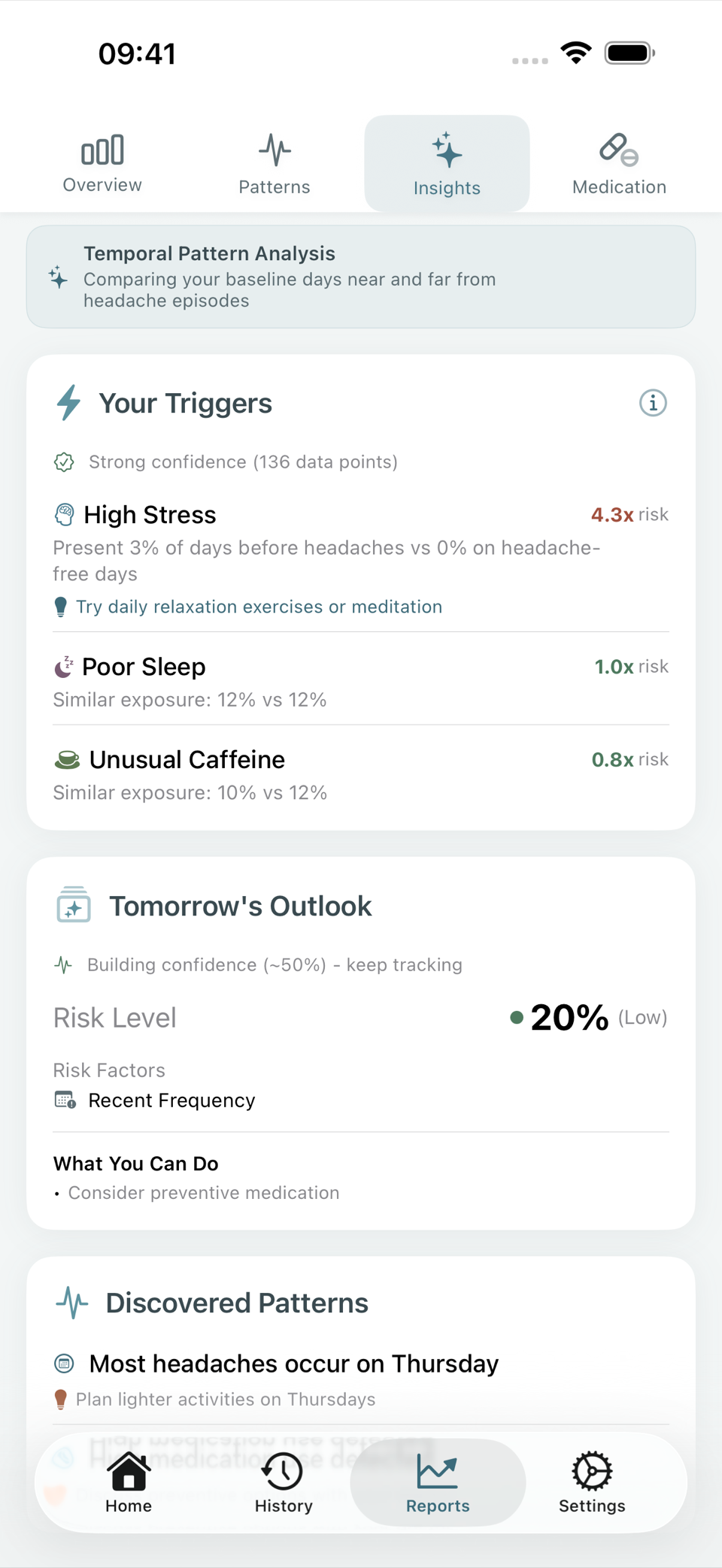
Cephalo is a private headache and migraine diary app for iPhone that works without an account and keeps data on your device. When an appointment comes up, Cephalo Plus condenses your diary into a doctor-ready PDF: headache history with intensity and duration, medication use by day, MIDAS scores, and pattern summaries, in a format made for appointments. A separate one-time unlock also opens PDF reports for 14 days. Generating a report is always an action you take; nothing is shared in the background.
The trigger and pattern summaries in the report come from the insights view, so you can sanity-check that part before handing it over:
Cephalo is a diary, not a doctor. It never gives medical advice; take your report to a healthcare professional you trust.
Your next appointment is a diary away. Start today and bring the picture, not the guesswork.

See how exporting works in the user guide, or read why a private diary matters in the first place.
Sources
- National Institute for Health and Care Excellence, “Headaches in over 12s: diagnosis and management” (CG150), recommendations 1.1.3 and 1.1.4, last updated June 3, 2025, nice.org.uk (accessed July 18, 2026). ↩
- The Migraine Trust, “Keeping a headache diary”, migrainetrust.org (accessed July 18, 2026). ↩
- Stewart WF, Lipton RB, Dowson AJ, Sawyer J, “Development and testing of the Migraine Disability Assessment (MIDAS) Questionnaire to assess headache-related disability”, Neurology 2001;56(6 Suppl 1):S20-8, pubmed.ncbi.nlm.nih.gov (accessed July 18, 2026). ↩